
New Species of Ambrosia Beetle Discovered at Takakuma Experimental Forest of the Faculty of Agriculture of Kagoshima University, Named “Takakuma-ōkikuimushi,” with Two New Records for Japan
Mr. Yogo Setiawan, a third-year doctoral student at the United Graduate School of Agricultural Sciences, Kagoshima University, discovered a new species and two new records of ambrosia beetles from Japan. This study is part of his doctoral research conducted at the Takakuma Experimental Forest of Faculty of Agriculture of Kagoshima University. The findings were published in the journal ZooKeys on 14 July 2026. The research was conducted in collaboration with several institutions, including an ambrosia beetle taxonomist from Michigan State University and researchers from Saga University and Universitas Brawijaya.
The newly discovered species has been named Hyorrhynchus takakumaensis Setiawan, Hata & Smith sp. nov. and Takakuma-ōkikuimushi as standard Japanese name. The species name refers to the locality where the species was collected in Takakuma Experimental Forest of Faculty of Agriculture of Kagoshima University, located in the Takakuma Mountains on the Osumi Peninsula, southern Kyushu, Japan.
In addition to describing one new species, Mr. Yogo also recorded two ambrosia beetle species that had not previously been reported in Japan. These species are Anisandrus auratipilus Smith, Beaver & Cognato, 2020 and Debus shoreae (Stebbing, 1907). The record of A. auratipilus from Japan represents only the second known record of this species worldwide since it was first described from Fujian, China. Meanwhile, D. shoreae is known to occur mainly in tropical regions of East and Southeast Asia.
The discovery of this new species and these new distributional records is important for documenting biodiversity and expanding our understanding of the biogeographic distribution of bark and ambrosia beetles. These beetles play important ecological roles in forest ecosystems by contributing to the decomposition of dead wood and nutrient cycling. However, some bark and ambrosia beetle species can also become important pests in agriculture and forestry, particularly when they attack living trees or spread into new geographic regions.
■ Publication Information
Title: A new species of Hyorrhynchus Blandford, 1894 (Coleoptera, Curculionidae, Scolytinae, Hyorrhynchini) and two new records of xyleborine ambrosia beetles from Japan.
Authors: Setiawan Y, Smith SM, Sakamaki Y, Tokuda M, Tarno H, Hata K
Journal: ZooKeys 1284: 347-356
DOI: https://doi.org/10.3897/zookeys.1284.195890
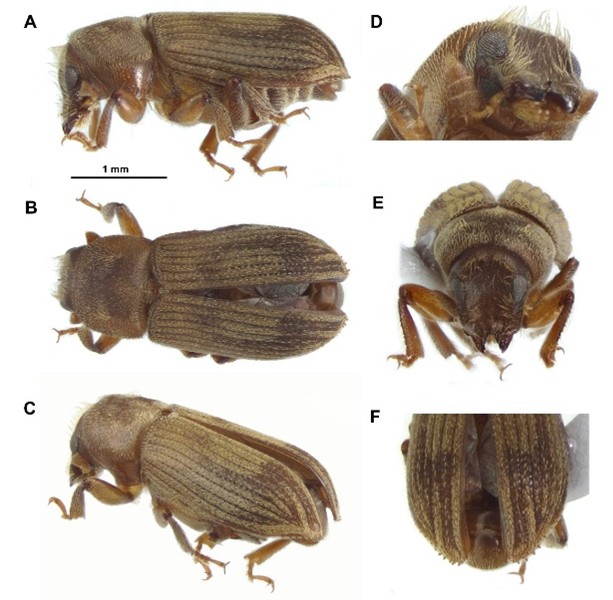
Hyorrhynchus takakumaensis Setiawan, Hata & Smith sp. nov.
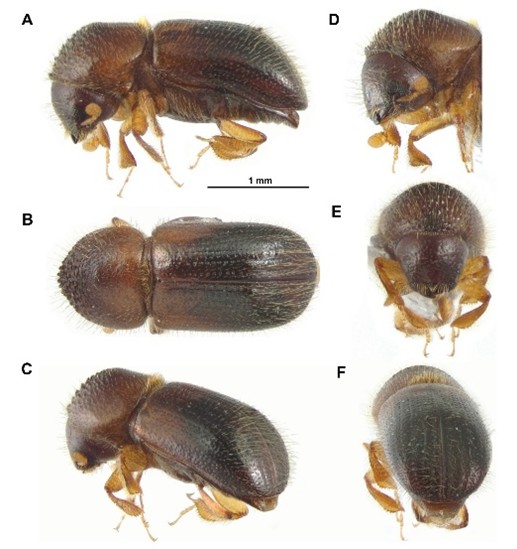
Anisandrus auratipilus Smith, Beaver & Cognato 2020
